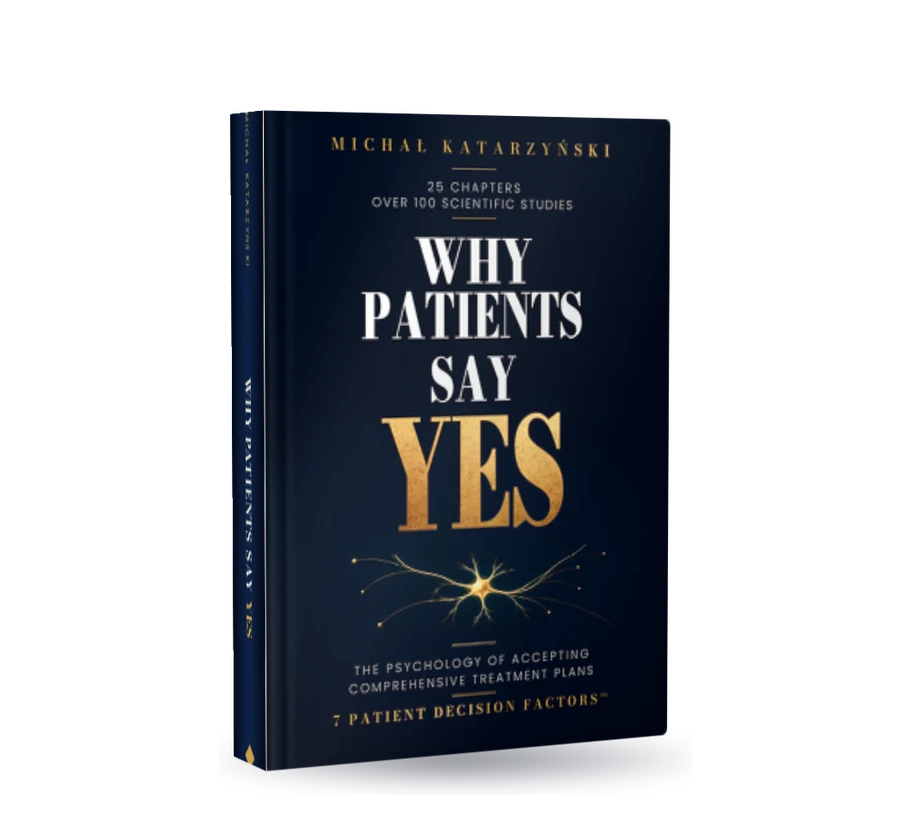

Why patients say YES
EN

Michał Katarzyński · Coming October 2026

45 minutes to decide on a $12,500 treatment plan.

A patient sits down with a doctor they met an hour ago… and has to make a decision about their health, their money, and their time. This book is about what goes on in their mind at that moment, and what every doctor can do about it so that the patient wants to go ahead with treatment.

Pre-order now

Available in hardcover, as an e-book, or both.

Drag to rotate

What’s in the book

Seven factors that together shape a patient’s decision

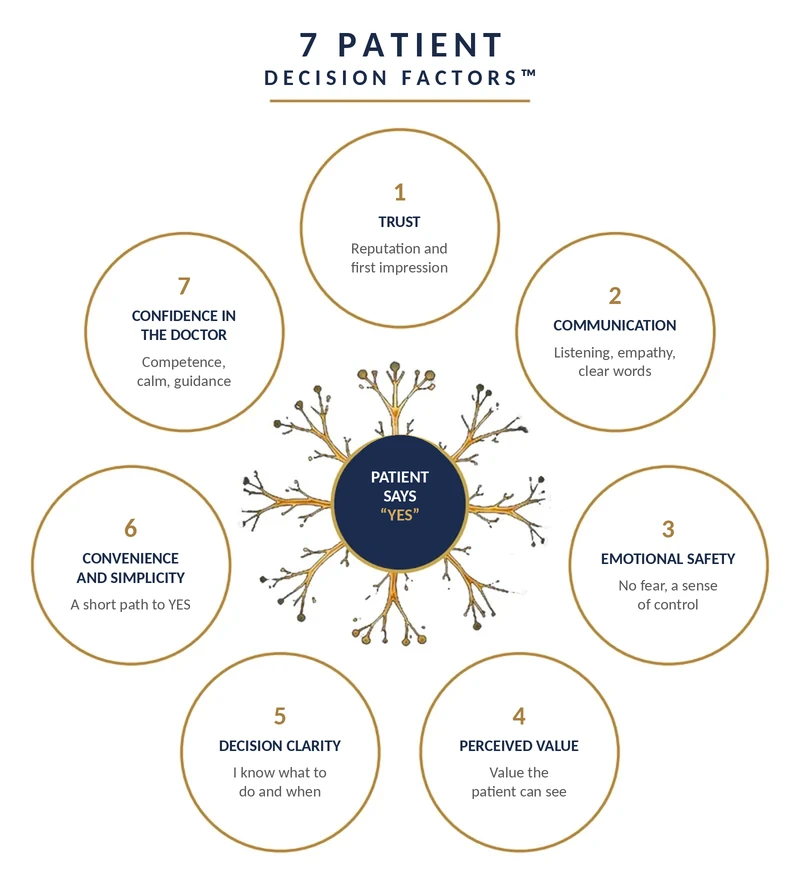
A map took shape from my work with dental practices: trust, communication, emotional safety, perceived value, decision clarity, convenience and simplicity, and confidence in the doctor.

Neglect one factor and the decision stalls, even if the other six are built perfectly. Each one gets its own chapter, with the psychological mechanism behind it, the research, the tools, and ready-to-use language for the conversation.

Figure 1 from the book. At the center, a neuron labeled Patient says YES, surrounded by seven equal factors: trust, communication, emotional safety, perceived value, decision clarity, convenience and simplicity, confidence in the doctor.
Figure 1. The seven factors that together shape a patient’s decision about treatment.

This is the only book in the world that organizes the mechanisms of treatment plan acceptance in this way and pairs them with concrete, practical solutions.

The ideal read for dentists and patient coordinators who present treatment plans, and sound advice for everyone on the team who is involved in treatment or works with patients.

Six original models

Six tools built over the past 14 years

  1. 17 Patient Decision Factors™A map of the seven dimensions that treatment plan acceptance is built from.Part II, Chapters 8–14
  2. 2Patient Motivation Model™ (M1–M4)The four states a patient can be in when they arrive for a consultation: how to recognize each one and how to fit the conversation to it.Chapter 6
  3. 33xP Model™Positives, Problems, Plan. The order in which the patient hears the diagnosis before hearing about the solution.From Chapter 2 on
  4. 47 STAR Model™Seven elements of a plan presentation: a SEXY goal, authority, steps, visualization, before-and-after photos, time, price.Chapter 11
  5. 54xA Protocol™Acknowledge, Ask, Adjust, Activate. How to respond to “I need to think about it,” “that’s expensive,” and “I need to talk to my partner.”Chapter 1 · in the free excerpt
  6. 6E.G.O. Model™Empathy, Boundaries, Expectations. How the team talks with a patient in a difficult situation.Chapter 22
Pre-order now

Available in hardcover, as an e-book, or both.

A patient accepts more than the plan. A patient accepts the person who presents it or will carry it out.

The book’s motto

Who it’s for

For everyone in the practice who talks with patients

  • DentistsYour conversation is the one that stays in the patient’s mind. You have little time for the consultation and a lot of expectations packed into every minute of it.
  • Patient coordinatorsYou walk the patient through the whole picture after the visit. Whether treatment actually happens often depends on you.
  • Dental assistants and hygienistsYou often have a great rapport with patients. That’s why they tell you what they don’t tell the doctor.
  • Front deskThe first contact with the practice. It decides whether the patient ever makes it to the chair.
  • Practice managers and ownersYou set the standards: how long a consultation takes, what the first contact looks like, how the team works.

How to use it

From a single consultation to a team standard

  1. Read the Introduction and Chapter 1Free, by email as soon as the English edition is ready. Where patients’ decisions come from, and the three meanings of “I need to think about it.”
  2. Try the 4xA Protocol™ at your next consultationThe toolkit from Chapter 1: ready-to-use language for the moment the patient wants to leave.
  3. Work through the seven factors and the four patient statesChapter by chapter, each with research, examples, and tools.
  4. Roll it out with your team over 90 daysChapter 25 is a 90-day implementation map, and Appendix B collects seven toolkits for everyday work in the practice.

Sources

Over 100 scientific studies.

Every study I cite has a note with its source. Appendix A covers eight well-known studies that replicate poorly or get overinterpreted: what they actually showed, why researchers dispute them today, and the caveat I attach when I cite them.

  • Mehrabian, 7 / 38 / 55
  • Kosfeld, oxytocin
  • Iyengar and Lepper, jams
  • Porges, polyvagal theory
  • Damasio, somatic markers
  • Beckman and Frankel, 18 seconds
  • Freedman and Fraser, foot in the door
  • Kahneman, peak–end
Where a study turned out, years later, to be weaker than it sounds in popular books, I preferred to leave a longer sentence with a caveat in the text rather than a shorter platitude […].
Appendix A, page 446

Contents

25 chapters, 3 appendices

Part IWhy patients don’t say YES
  1. —Introduction1
  2. 1Why patients say “I need to think about it”14
  3. 2Why medical knowledge isn’t enough45
  4. 3The psychology of decision: how the brain chooses health61
  5. 4The neurobiology of fear: the patient’s brain in survival mode79
  6. 5Communication traps: the most common consultation mistakes95
  7. 6The Patient Motivation Model™ (M1–M4)115
  8. 7The Patient Journey: from the first visit to a comprehensive treatment plan133
Part IIThe 7 Patient Decision Factors
  1. 8Trust: the foundation without which nothing works159
  2. 9Communication: the bridge between fact and feeling176
  3. 10Emotional safety194
  4. 11Perceived value212
  5. 12Decision clarity235
  6. 13Convenience and simplicity250
  7. 14Confidence in the doctor: the reputation that enters the room before you do266
Part IIIA system for high-acceptance consultations
  1. 15The magic of the first 90 seconds282
  2. 16The psychology of price: talking about cost without fear297
  3. 17The architecture of safety: listening that heals314
  4. 18The emotional side of dentistry – the WOW effect329
  5. 19The Excellent Consultation Protocol: five stages of high acceptance347
  6. 20A patient for life: the hygienist’s role357
  7. 21Presenting the plan: from the problem to a new quality of life (Smile Design)365
  8. 22The team as a guarantor of the decision: the role of the front desk and assistants378
  9. 23Scaling success: one standard across the whole practice398
  10. 24A new era: AI and the future of patient communication416
  11. 25The reader’s first 90 days: an implementation map433
AppendicesSources and tools
  1. AStudies I use with caution – and why446
  2. BSeven toolkits – the book’s working tools460
  3. C50 reasons patients stay silent – a diagnostic map464
Chapter 1pages 23–26

Toolkit: The 4xA Protocol™

The 4xA Protocol is a four-stage structure for responding to the sentence “I need to think about it.” It works most fully with M3 and M4 patients. With M1 and M2 patients it needs adapting, because there you first have to build awareness or motivation.

AcknowledgeAskAdjustActivate

Stage 1: Acknowledge the objection

Goal: lower the patient’s guard by accepting the objection as legitimate. The patient arrives expecting a counterattack. Your job is to break that expectation in the first second.

The first response to “I need to think about it” can’t be an argument, or even a question; it has to be a threefold acknowledgment: for the information, for the honesty, for the objection itself.

Objection: “That’s expensive”

“I’m glad you said that. Thank you for being open about money; many patients prefer to keep that quiet. You’re right, it’s a significant amount. This isn’t a decision you make without thinking it through.”

The most common mistake: acknowledgment paired with an immediate argument.

“I understand you want to think it over. BUT I’d like to point out that the sooner…”

That isn’t Acknowledge. The patient hears only what comes after “but.”

Acknowledgment has to be a full, separate, freestanding act. After it, you stay silent. You wait for the patient’s reaction. That silence after Acknowledge is part of the tool.

Acknowledge the patient’s objection – no “but,” no pressure, no attempt to soften it. Only then does the real conversation begin.

Free excerpt

Read it before you decide

  • The full Introduction: why patients say “no,” and how I know.
  • The full Chapter 1: three versions of “I need to think about it” (the protective screen, the financial smokescreen, unspoken distrust) and the 4xA Protocol™ toolkit.
  • The complete table of contents and Figure 1 with the seven factors.
  • PDF to your email as soon as the English edition is ready.

No phone calls and no daily emails. I’ll use your address only for news about this book.

Michał Katarzyński, the author.

Author

How I know this

I’m not a doctor. Since 2012 I’ve worked with dental practices in Poland, Germany, Sweden, and the United Arab Emirates. I’ve seen this profession from four sides:

  • ConsultantOver 200 practice audits. Documents, consultation statistics, patient pathways.
  • TrainerOver 6,000 people trained. Lectures for Dentsply Sirona, Digital Smile Design Academy, the Dawson Academy, and Align – Invisalign.
  • Co-managing partnerSeveral years co-managing a network of practices in three locations, from two to eleven chairs.
  • PatientOver three hundred consultations in the chair as a patient-trainer. The same teeth, the same scans, and about two hundred different treatment plans.

From 44 to 76 percent

Treatment plan acceptance rose from 44% to 76% in a practice I worked with for two years. In another, a five-chair practice, the first year after implementation brought over $500,000 in additional profit.

These are the results of implementation work in those practices, not of reading alone. I’m also not claiming that patient communication alone is behind them. But it was the lever, and without it, fuller chair schedules and tighter costs would have had nothing to lift.

From 2017 to 2026

This is my second book, written nine years after the first and a far more mature one. The first, “7 potrzeb pacjentów stomatologicznych” (The 7 Needs of Dental Patients), came out in 2017.

Language editions

One book, seven languages

Polish, English, Portuguese, Spanish, German, Italian, and French. The same content, the same models and tools, wherever a doctor talks with a patient about a treatment plan.

On this page you’re ordering the English edition. You can choose other languages in the switcher at the top of the page.

Covers of the six translated editions: English, Portuguese, Spanish, German, Italian, and French.

The math

Less than 1% of a plan the patient decides on in 45 minutes

The plan on the first page of this book costs $12,500. The hardcover is $79, or 0.6% of that amount. Even both editions together, $99, come to 0.8%.

In Chapter 11 I write that patients don’t pay for titanium or ceramics, but for what they get for the next fifteen years or so. This book works the same way: it’s an investment in the conversation you have after every consultation where the price comes up.

No book will make the decision for the patient. This one shows what goes on in their mind before they make it.

What the hardcover costs relative to a $12,500 plan.

Treatment plan from the book’s opening scene$12,500
One implant with a crown (the rate used in the book)$1,900
Book, hardcover: $79Treatment costBoth bars are on the same scale as the book’s price.

Editions and prices

Choose your edition

Each has the same content: the Introduction, 25 chapters, 3 appendices, and over 100 studies in the notes.

Pre-order
The e-book on a tablet: the book cover on the screen.

E-book

For reading on a computer, tablet, or phone.

59

Pre-order: PDF to your email on release day

  • PDF with the same layout as the print book
  • The same figures and notes
  • Full-text search
Pre-order the e-book
Pre-order
The hardcover book, shown with its spine.

Hardcover

For reading with a pencil in hand, and for the shelf in your office.

79

Pre-order: ships when the print run is complete

  • B5 format (6.9 × 9.8 in), 480 pages
  • Hardcover binding
  • First edition, 2026
Pre-order the hardcover
Pre-order
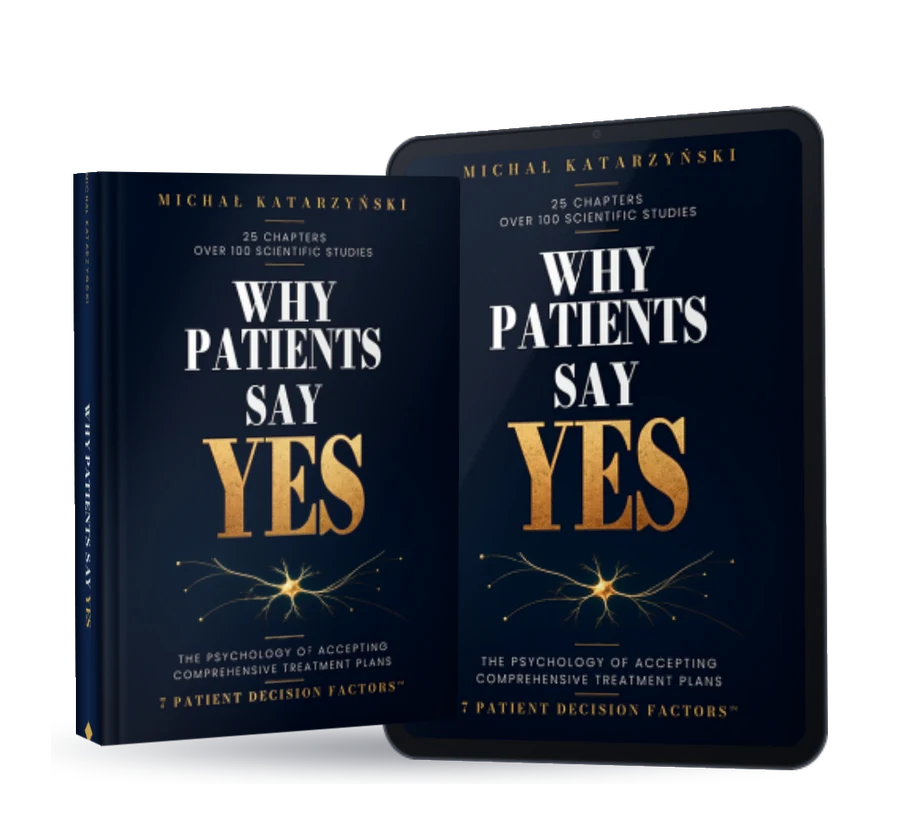
The hardcover book and a tablet with the e-book, side by side.

Hardcover and e-book

Paper for reading, the e-book for quick look-ups in the office.

99

Bought separately: $79 + $59 = $138

Pre-order: ships when the print run is complete

  • Hardcover, B5, 480 pages
  • PDF e-book
  • Both editions in one order
Pre-order both

Not ready to decide? Read the Introduction and Chapter 1 first.

Get the free excerpt

Questions

Before you order

Is this a book about sales?

No. The second part of the Introduction is titled “This Is Not a Sales Manual,” and it opens with a question you may be asking yourself too: isn’t learning how to talk with patients just learning how to manipulate them?

The line runs through intent, not method. The tools in this book work only when the diagnosis is honest and the plan fits what the patient actually needs. That section is in the free excerpt.

Where does this knowledge come from?

From fourteen years of work with practices: over 200 audits, in-house training for entire teams, several years co-managing a network of practices, and over three hundred consultations where I sat in the chair as a patient-trainer. Plus over a hundred scientific studies in the notes.

The manuscript was read by more than a dozen dentists from different practices and cities. Their comments on diagnostics, treatment planning, and clinical terminology are reflected in the text, and they’re listed by name in the acknowledgments.

Is the book also for patient coordinators, assistants, and the front desk?

Yes. The Introduction says plainly that I’m writing it for everyone who works in dentistry and has contact with patients. Chapter 20 is about the hygienist, and Chapter 22 is about the front desk and assistants.

What format is the e-book?

A PDF with the same layout as the print edition: the same pages, figures, and notes. You can open it on a computer, tablet, or phone. With a pre-order, the file arrives in your inbox on release day.

Can I get an invoice for my practice?

Yes. When you order, enter your tax ID and the name of your practice.

What exactly is in the free excerpt?

The full Introduction, the full Chapter 1 with the 4xA Protocol™ toolkit, the complete table of contents, and Figure 1. It comes as a PDF to your email as soon as the English edition is ready.

There are no difficult patients. Only difficult situations.

Start with the first of them: the sentence you hear most often after a consultation where the price comes up. “I need to think about it.”

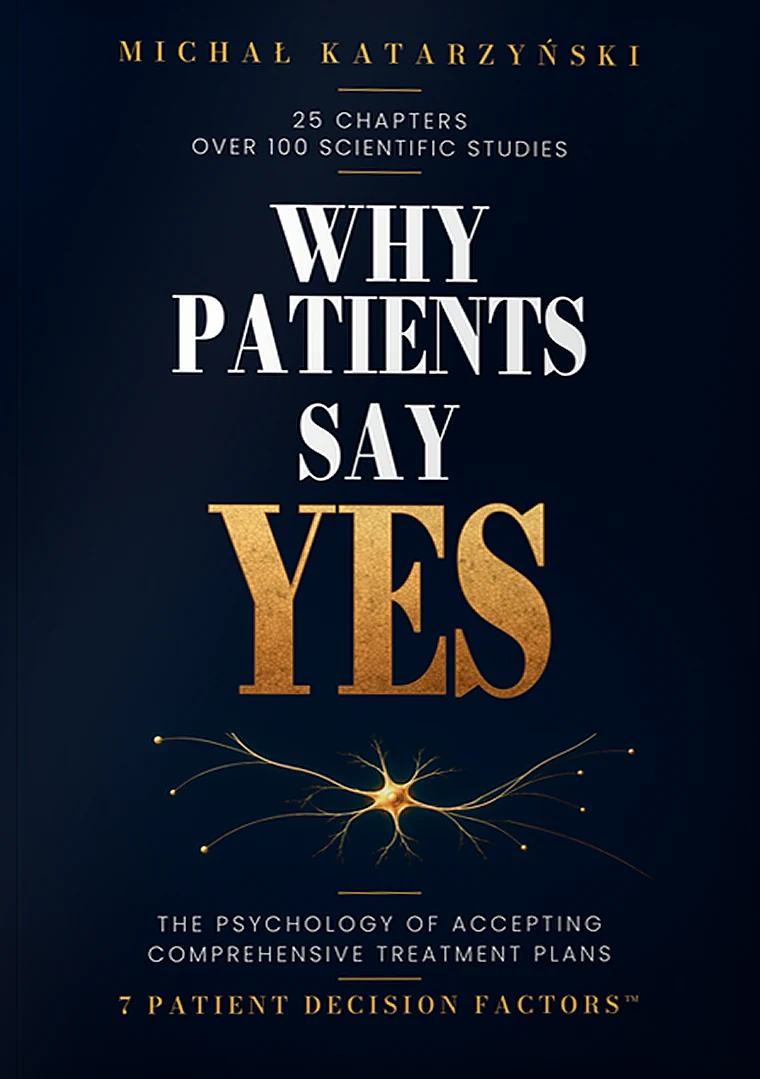
Cover of Why Patients Say YES.

Your order

I’ll send a confirmation and payment details to the email address you provide.